
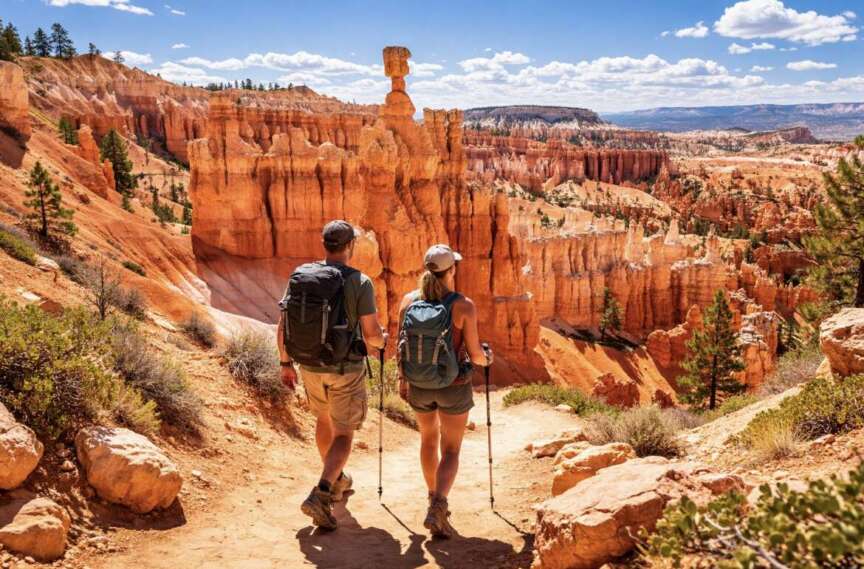
The Rim Trail gives you the postcard. The trails below give you the whole story. Bryce Canyon’s longer day hikes drop you into the hoodoos, loop you through quiet backcountry forest, and bring you back up to the rim tired and happy. Every trail on this list takes three hours or more, and several fill the better part of a day.
This guide is built for hikers who have already done the short classics. If you’re traveling with little ones, start with our family-friendly Bryce Canyon hikes! Here, trails are grouped by how big a day you want, and each one comes with a season rating so you can match the hike to your travel dates.
All trail stats come from the National Park Service. Trail conditions change, so always check the park’s current conditions page before you go.
Before You Lace Up: Three Things Every Bryce Hiker Should Know
You go down first and climb out last. Almost every trail below the rim starts with a descent, which means the hardest climb comes at the end of your hike, when your legs are already tired.
The air is thin. Bryce Canyon sits between 8,000 and more than 9,000 feet. Even fit hikers feel it. Take the climbs slowly and drink more water than you think you need. The NPS recommends about one quart (one liter) per person for every two to three hours of hiking, and there is no water on these trails.
Boots matter. The park reports that shoes not made for hiking are the top cause of rescues and hospital-visit injuries in Bryce Canyon. Wear real hiking footwear with good grip.

Half-Day Hikes: Big Scenery in a Morning
Bryce Amphitheater Traverse
4.7 miles one way | 1,145 ft elevation gain | 3 to 4 hours | Strenuous
Want the best of Peekaboo and Queen’s Garden without hiking a loop back to your car? The Traverse is a one-way route: start high at Bryce Point, swing clockwise around the Peekaboo Loop, then climb out through Queen’s Garden to Sunrise Point. Because it ends somewhere different from where it starts, it pairs perfectly with the park shuttle.
Season: Best late spring through fall. The NPS notes it may be inaccessible in mid-winter, when snow can reach 2 to 15 feet.
Good to know: You’ll share Peekaboo with horse and mule rides. Give riders the right of way. Bathrooms are on the west side of Peekaboo in summer.
Peekaboo Loop from Bryce Point
5.5 miles | 1,560 ft elevation gain | 3 to 4 hours | Strenuous
Peekaboo earns its name one turn at a time: every bend in the trail reveals a new window, spire, or fin of red rock. Starting from Bryce Point, the highest of the amphitheater viewpoints, gives you a long, dramatic descent before the loop itself.
Season: Late spring through fall. The NPS recommends hiking the loop clockwise.
Good to know: Horses and mules use this trail in summer. Step to the side and let them pass.
Hat Shop
4.0 miles out and back | 1,380 ft elevation change | 3 to 4 hours | Strenuous
Most visitors never see Hat Shop, and that’s the appeal. This trail follows the start of the Under-the-Rim Trail down from Bryce Point for two miles to a cluster of narrow orange hoodoos capped with gray boulders, like a row of spires wearing hats. Along the way, long views stretch south to the colorful cliffs of the Grand Staircase.
Season: Best late spring through fall. The descent is easy going; the two-mile climb back to Bryce Point is not, so avoid midday heat in July and August.
Good to know: This is a backcountry trail. Signage is lighter than in the amphitheater, so carry a map.
Swamp Canyon Loop
4.0 miles | 800 ft elevation change | 3 to 4 hours | Moderate
Swamp Canyon trades crowds for forest. From the overlook, the loop drops into a quieter, more rugged corner of the park with pine forest and smaller, more intimate hoodoo views. It’s the right pick when the amphitheater trails are busy and you want the canyon mostly to yourself.
Season: Summer and fall. Snow can linger on shaded sections into spring.
Good to know: The NPS recommends carrying a map for this trail.
Full-Day Hikes: The Signature Bryce Experience
Figure-8 Combination
6.4 miles | 1,575 ft elevation gain | 4 to 5 hours | Strenuous
If you only have one big hike in you, make it this one. The Figure-8 links Queen’s Garden, the Peekaboo Loop, and the Navajo Loop into a single route through the heart of the Bryce Amphitheater. You’ll walk under the Wall of Windows, pass Queen Victoria and Thor’s Hammer, and climb out on the Navajo switchbacks.
How to hike it: The NPS recommends starting at Sunrise Point, descending Queen’s Garden, hiking Peekaboo clockwise, and climbing out on either side of the Navajo Loop. A short Rim Trail walk brings you back to Sunrise Point.
Shorter version: The Navajo/Peekaboo Combination skips Queen’s Garden and runs 4.9 miles from Sunset Point.
Season: Spring through fall, and in winter when conditions allow. In summer, start early. In winter, the Wall Street side of the Navajo Loop closes, so climb out via Two Bridges instead. Winter hiking here requires traction devices and a check of current conditions.
The Rim Trail, End to End
5.5 miles one way | 1,330 ft elevation gain (south to north) | 3 to 4 hours | Easy to moderate
Most people walk the paved half-mile between Sunrise and Sunset Points. Walk all of it instead. The full Rim Trail connects every viewpoint in the amphitheater, from Bryce Point in the south to Fairyland Point in the north. You stay above the hoodoos the whole way, so it’s a strong choice for anyone who wants distance and nonstop views without dropping below the rim. Linger at every overlook and it easily becomes a full day.
Season: Sections are open year-round. The NPS closes the stretch between Bryce Point and Inspiration Point in winter.
Good to know: Use the shuttle to hike one way. Fairyland Point has no shuttle stop, so plan to end at a shuttle stop or hike back.
Epic Days: For Hikers Who Want It All
Fairyland Loop
8.0 miles | 1,900 ft elevation gain | 4 to 5 hours | Strenuous
Fairyland is where Bryce gets quiet. This loop circles Boat Mesa at the north end of the park, mixing rim walking with long canyon stretches past the China Wall, tall hoodoos, and a short spur to Tower Bridge. Many visitors drive right past this part of the park, so you’ll see far fewer people than on the amphitheater trails.
How to hike it: Start at Fairyland Point or at the Tower Bridge Trailhead north of Sunrise Point. The NPS recommends a counterclockwise direction, which lets you descend rather than climb the Tower Bridge section.
Shorter version: Tower Bridge on its own is a 3-mile out-and-back from the Tower Bridge Trailhead, with views of the China Wall along the way.
Season: Spring and fall are ideal. Summer is doable with a very early start, since parts of the loop are exposed. In winter, the road to Fairyland Point closes to vehicles, so start from the Tower Bridge Trailhead instead, conditions permitting.
Good to know: There’s no shuttle pickup at Fairyland Point. Pack extra water.
Riggs Spring Loop
About 8.5 miles | 2,200+ ft elevation gain | 4 to 6 hours | Strenuous
The biggest day hike in the park starts at the top of it. Riggs Spring begins at Yovimpa Point, at the far southern end of the scenic drive, and drops through spruce, fir, and bristlecone pine forest with long views of distant cliffs. The western side is steeper and more heavily forested. Fewer hoodoos, far more solitude.
Season: Summer and early fall. At this elevation, Riggs Spring stays cool when the rest of southern Utah bakes, but it’s also the last trail to melt out in spring. The NPS notes snow depths of 2 to 15 feet in mid-winter.
Good to know: No permit is needed to day hike, but there are no water-fill stations and no shuttle service. Cool down afterward on the easy 1-mile Bristlecone Loop nearby, which passes bristlecone pines up to 1,800 years old at over 9,100 feet.
Which Hike, Which Season?
Spring (April to May): Amphitheater trails open up first. Expect lingering snow and mud on shaded stretches and at higher elevations. Pick the Figure-8, the Traverse, or Tower Bridge, and save Riggs Spring for later in the year.
Summer (June to August): Bryce is the coolest of Utah’s national parks thanks to its elevation, which makes it the summer escape from the desert heat. This is prime time for Riggs Spring and Swamp Canyon.
Fall (September to October): The best hiking season of the year. Cooler days, thinner crowds, and every trail on this list is in play. Fairyland is at its best now.
Winter (November to March): Quiet, snow-dusted hoodoos for those who come prepared. Stick to trails the park keeps accessible, such as the Rim Trail sections, Two Bridges on the Navajo Loop, and Tower Bridge. Bring traction devices and check conditions daily.

Build Your Big Day from Ruby’s Inn
A long day on the trail starts with a good morning and ends with a better evening. Ruby’s Inn is the closest lodging to Bryce Canyon, which means you can be at a trailhead while other visitors are still on the highway.
Fuel up free. Start your day with our hot breakfast buffet, complimentary with your stay before you head out, and grab trail snacks and supplies at the Ruby’s Inn Store.
Skip the parking hunt. During shuttle season, catch the park shuttle from Ruby’s Inn and hop off at the trailhead. It also makes one-way routes like the Traverse and the Rim Trail easy.
Recover right. Soak tired legs in the indoor pool, then refuel with dinner on-site before tomorrow’s hike.
Stay your way. Choose Ruby’s Inn, The Grand, Bryce View Lodge, or the Ruby’s Inn Campground and RV Park. One basecamp, a stay for every budget, and the canyon right next door.
Plan your Bryce Canyon hiking trip. Discover more at Ruby’s Inn.
Frequently Asked Questions
What is the best long day hike in Bryce Canyon?
The Figure-8 Combination is the park’s best all-around long hike: 6.4 miles through the heart of the Bryce Amphitheater, combining Queen’s Garden, Peekaboo, and the Navajo Loop. For more solitude, choose the 8-mile Fairyland Loop.
What is the hardest day hike in Bryce Canyon?
The Riggs Spring Loop, at 8.6 miles and 2,200 feet of elevation gain, is the biggest day hike in the park. It has no water sources and no shuttle service.
Do I need a permit to day hike in Bryce Canyon?
No. Day hikes, including Riggs Spring and sections of the Under-the-Rim Trail, do not require a permit. Overnight backcountry stays do.
Can you hike Bryce Canyon in winter?
Yes, many of the park’s trails stay open. Only two close for the whole season: the Wall Street side of the Navajo Loop and the Rim Trail between Bryce Point and Inspiration Point. That leaves plenty of options, from easy walks like the Rim Trail and Mossy Cave to longer days below the rim. The Queen’s Garden/Navajo Loop (via Two Bridges), the Navajo/Peekaboo Combination, the Figure-8, and even the 8-mile Fairyland Loop are all winter hikes when conditions allow. The road to Fairyland Point closes to cars, so start Fairyland from the Tower Bridge Trailhead near Sunrise Point. Traction devices are a must, and snowshoes help after a fresh storm. Always check the park’s conditions page or talk with a ranger before you hit the trail.
When is the best time to hike Bryce Canyon?
Fall is the best season for longer hikes, with cooler temperatures and every trail open. Summer is also excellent if you start early, since Bryce’s elevation keeps it cooler than Utah’s lower-elevation parks.
Are dogs allowed on Bryce Canyon trails?
Pets are allowed only on the paved Rim Trail section between Sunrise and Sunset Points, on a leash. None of the longer day hikes in this guide allow pets.